Materials
The Case for the Void Layer
Eight of STRATA’s one hundred layers contain nothing at all. Dr. Lionel Achterberg explains why nothing is the hardest material we make.
By Dr. Lionel Achterberg, Chair of Negative Space3 min read663 words
Every week, someone writes to ask why they have paid for layers that are empty. It is a reasonable question. I have spent most of my career on it.
What a Void Layer is
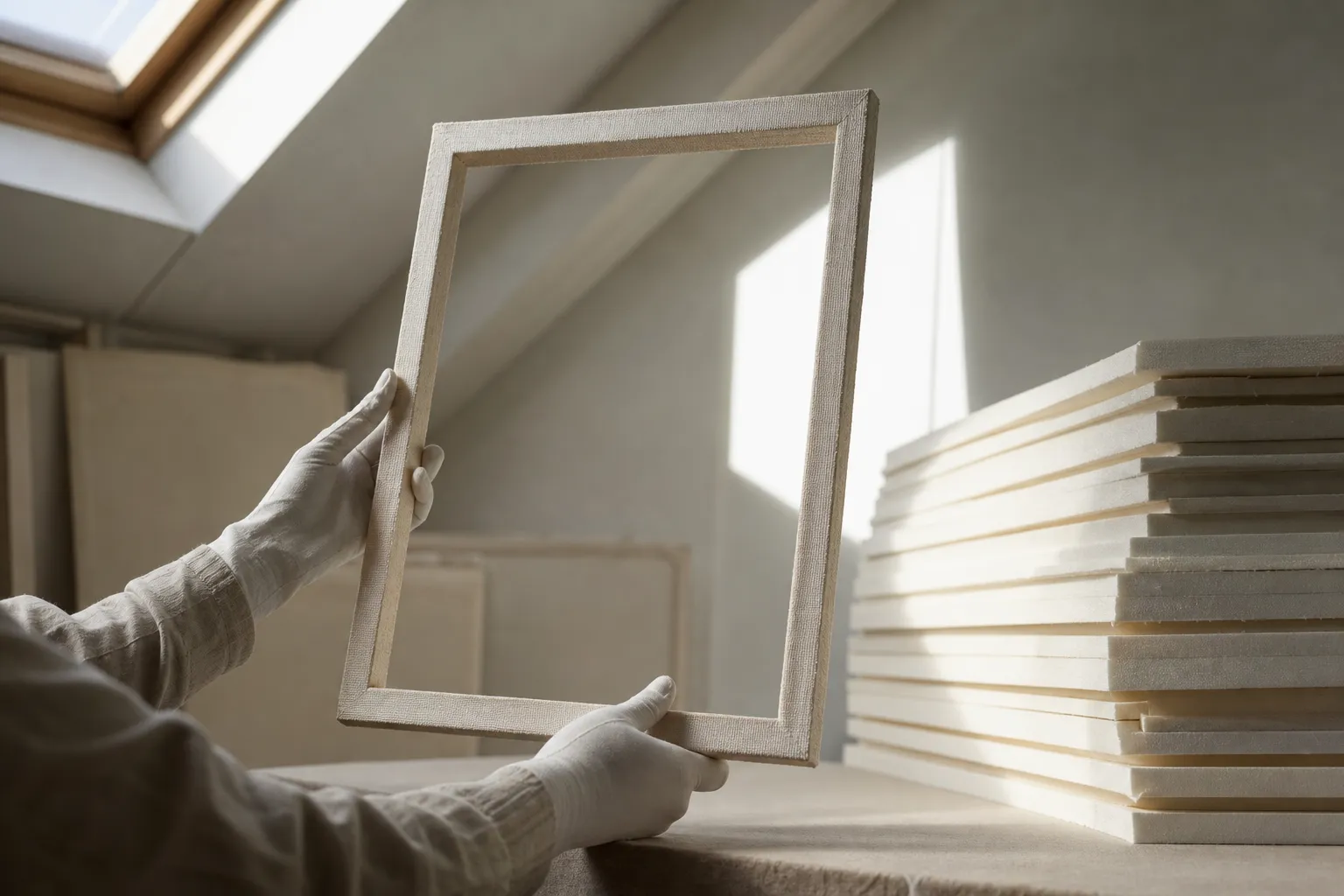
A Void Layer is a tensioned linen frame, 2.0 millimetres deep, containing air and nothing else. It weighs 3 grams, almost all of which is the frame. There are eight of them in every full stack, at Layers 13, 30, 50, 64, 77, 87, 91 and 99. They are not gaps in the stack. They are part of it.
What nothing does
A pillow made only of material is a pillow that cannot rest. Every layer pushes on the one below, and the one below pushes back. Over a night, this produces what we call cumulative press: a slow, almost imperceptible stiffening of the whole stack.
A Void Layer interrupts that press. The layers above it settle onto air, briefly, before they meet the layers below. That pause is small. It is also, according to our VOID-1 study, worth an 18.2% greater sense of space on waking among sleepers given genuine Void Layers.
I should be honest about VOID-1. Its sample was 88 sleepers. Its result was significant at p = 0.049, which is to say only just. And our placebo Void Layers, which were identical frames, equally empty, were made on a Tuesday. Our mill foreman believes this may have affected them. I believe they were empty in a different way. We are repeating the study as VOID-2, with the placebos made on a Wednesday.
How nothing is made
Void Layers are the slowest layers we make. Each frame is cut from a single length of linen, tensioned by hand, and stitched in a room at the mill that we keep deliberately sparse. There is a chair, a table, a lamp and a window. There used to be a clock. We removed it after we found that frames stitched within sight of it were 4% less restful.
Each Void Layer is then inspected, which is harder than it sounds. Inspecting a layer for defects is straightforward when the layer contains something. When it contains nothing, the inspector must confirm that the nothing is complete. Our Void Operations team does this by holding each frame up to the north window for exactly nine seconds. If they see anything in it, it fails.
The Midpoint
Layer 50, Void III, is the most photographed layer in STRATA. It sits exactly halfway down the stack, and sleepers find it very moving. We receive photographs of it framed, photographs of it held up to sunsets, and one photograph of it being used, briefly, as a tennis racket. We did not recommend this. We did not ask for it back.
Objections
“Couldn’t you just leave a space?” No. A space is an absence. A Void Layer is a presence that happens to contain nothing. The frame holds its shape. The air is held in place. The difference is the whole point.
“Am I sleeping on nothing?” If your Number ends on a Void Layer, then yes, technically, your last layer is nothing. Sleepers with Numbers of 13, 30, 50, 64, 77, 87, 91 or 99 report that this is a calm feeling. One described it as “being caught by an idea”.
“Can I buy one on its own?” Not yet. Void Layers are only sold as part of a full stack. We believe nothing should be taken out of context.
A closing thought
I am sometimes asked whether I find it frustrating to have dedicated my life to a material that is not there. I do not. Every other material in STRATA does something. The Void Layer allows. In a stack of one hundred busy layers, eight of them are simply making room.
That is the case for the Void Layer. I have tried to make it at length. It could also have been made with nothing at all.