Origins
Why 100?
We tried 64. We tried 128. We tried 99 for a very long weekend. Here is how we arrived at the only number that works.
By Ines Wrenfield, Founder and Chief Layer Officer3 min read621 words
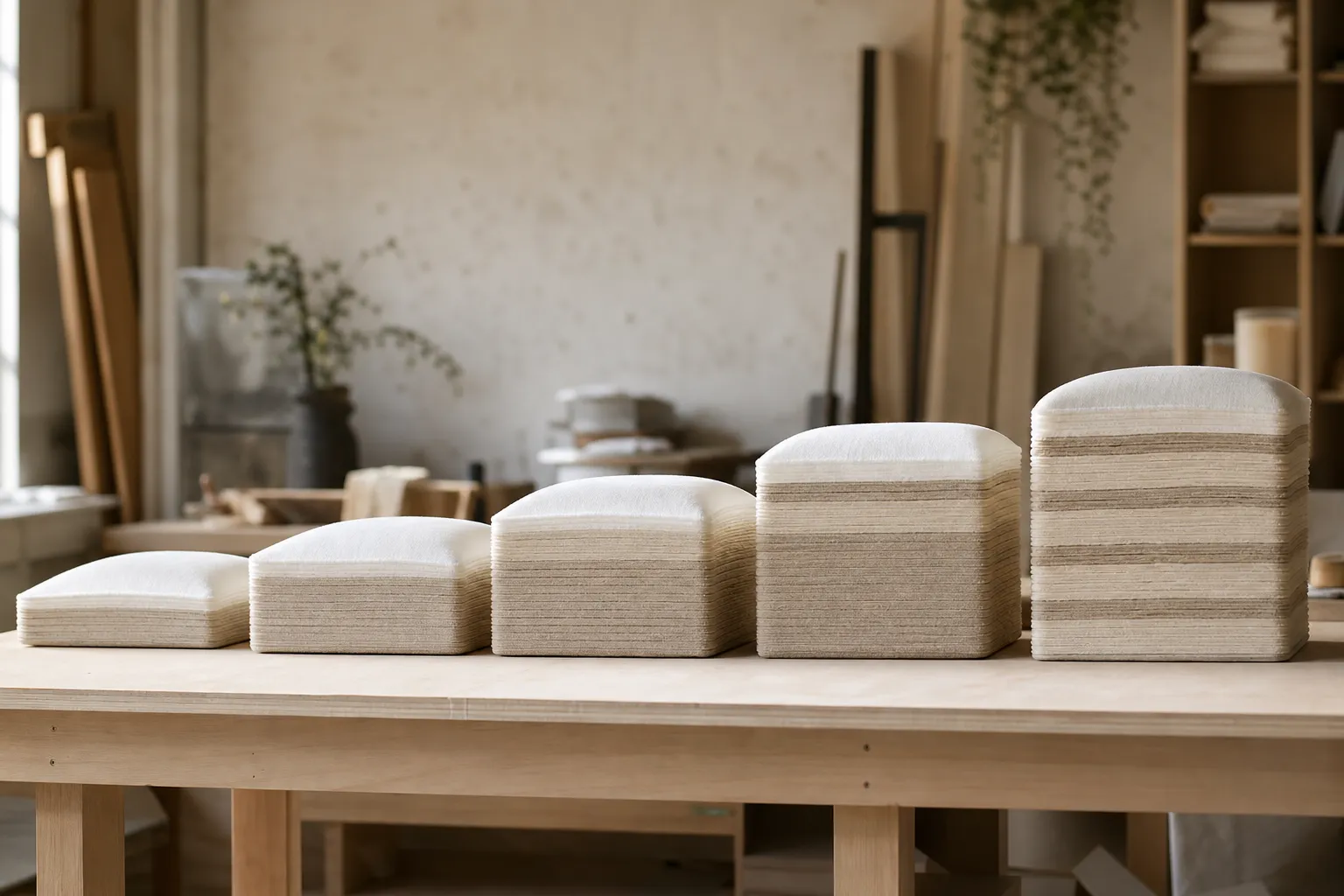
People ask why STRATA has one hundred layers. Usually they ask politely. Sometimes they ask the way you would ask why a friend has bought a second canoe. Both are fair. This is the long answer.
The first stack
In the spring of 2019 I was an acoustic-foam engineer with a sore neck and nine pillows. One night, out of frustration, I stacked three of them and removed the middle one. Then I put it back and removed the top one. By two in the morning I had a small mountain on the bedroom floor and a single, unwelcome thought: a pillow is not one thing. It is a set of layers that have been glued together and sold as one thing.
If a pillow is layers, then the right pillow is the right number of layers. The question was how many to start with.
Too few
We built the first prototypes at 24 layers, because that was how many sheets of foam fitted in the bakery oven we were using as a curing chamber. Twenty-four was not enough. Testers found that each removal was too large a step. They would be uncomfortable at 14 layers and uncomfortable at 13, and the comfortable place was somewhere in between, where no layer existed.
We went to 48, then 64. At 64 the steps were smaller, but our testers kept running out of stack. Tall sleepers, back sleepers and one retired steelworker reached the top and asked for more.
Too many
So we built a 128-layer prototype. It stood 289 millimetres high and weighed just over five kilograms. It took eleven minutes to make the bed. One tester described the Protocol at 128 as “less a sleep programme than a career”. Average nights to Number rose to 19.6. Two testers stopped journaling in the second week and have not been heard from since, though we understand they are well.
Ninety-nine
For a long weekend in 2020 we were convinced the answer was 99. It is a beautiful number. It suggests that something is almost complete. We built six stacks. On the Monday, Dr. Reyes-Whitlock walked into the workshop, looked at them for some time, and said, “It feels like it is waiting for something.” She was right. Every tester at 99 reported the same vague sense of incompleteness, which we now call Ninety-Nine Unease. We have not been able to measure it. We have not been able to ignore it.
One hundred
At one hundred layers, three things happened at once.
- The steps became small enough. Each layer averages 2.26 millimetres. Below about 2.5 millimetres, our testers could feel a single removal but could not be overwhelmed by one.
- The range became wide enough. The full stack covers every Number we have ever recorded, from 1 to 100, with room at the top for the 0.8% of sleepers who need all of it.
- The arithmetic became honest. A Number of 52 means 52 out of 100. Anyone can understand it. Nobody has to convert anything.
We also found room for eight Void Layers, at 13, 30, 50, 64, 77, 87, 91 and 99. The last of those, Void VIII, sits where we spent that long weekend. It is our quiet tribute to Ninety-Nine Unease, and it is, by design, empty.
The answer
So: why 100? Because 24 was too coarse, 64 was too short, 128 was too long, and 99 was unfinished. One hundred is the smallest number of layers that lets every neck we have met find its place, one small step at a time.
It is also, I will admit, a very satisfying number to say out loud. We tested that too.